For high-stakes, hard-to-reverse decisions
The decision is almost made. Check what you may be missing.
Describe the situation. Opponentura challenges not only the decision, but the frame around it: what is being treated as fact, which assumptions carry the case, which options have already been excluded and how the situation looks from the other side. The result is what you may be missing, what to verify first, and what should make you proceed, revise or stop.
For that, several independent roles first examine the case separately from one another, and then argue out where they disagree. External facts — and the severity of the criticism itself — go through additional review.
Your review runs in the language you write in. Write in English and the hearing, the bot and the sealed report are English; write in Russian and they are Russian. English reports are on the samples page — download one and check its hash before you decide.
5–15 minutes to describe the case · first result usually the same day · no obligation to unlock the full report · opens our Telegram bot.

When another opinion is not the point
Not every decision needs a red team
Opponentura is for decisions where the cost of a wrong assumption is materially larger than the cost of one more structured check — and it is most useful when the decision has already been discussed for a long time inside one stable frame.
The decision is nearly made
You have discussed it already. What you need now is not another preference — it is a deliberate search for the assumption that may have gone unchallenged.
Reversing it will be expensive
A buyout, financing, a long contract, a restructuring, a product launch. Signing takes a minute; unwinding can take months or years.
Several options still look reasonable
The useful question is not “which one do you like?” but “under what conditions does each option stop making sense?”
The map is not the territory. Every decision is made from a model of reality. Opponentura is a separate attempt to find where that model may be incomplete: what is treated as fact, what has fallen outside the frame and where the map may no longer match the territory.
A principle associated with Alfred Korzybski.
Clarity, not a longer list of risks
A useful review should change what you know or what you do
First result — on us
Verdict. Does the current decision hold, need reshaping, or fail the review in its current form?
Key assumption. The single assumption the decision depends on most.
First test. The cheapest practical way to challenge that assumption before the main commitment.
The full Decision Review Report
The sealed PDF opens with The essentials and adds:
- the risk you are taking — what is at stake, the size of the downside and whether the step is reversible;
- the three most dangerous assumptions and what each rests on;
- what to change in the terms, numbers or sequence;
- a revision condition — the fact or threshold that should change the decision;
- a concrete action plan;
Write in English and the sealed report is English — real examples are on the samples page, hash included.
What changes in one review?
Before
The decision is nearly made
- “we have probably covered it”;
- a residual doubt remains;
- it is unclear what else to check;
- several options still seem defensible.
Review
Challenge the frame, then the decision
- the question itself;
- facts and assumptions;
- excluded alternatives;
- the other side’s view;
- consequences and scenarios.
After
The decision has explicit conditions
- what may sit outside the current frame;
- what may have been missed;
- what to test first;
- what to change;
- what would justify proceeding;
- what should make you stop.
Opponentura does not make the decision for you. It makes the conditions of the decision explicit.
Not a mock-up
What does the customer actually receive?
A few reports are open as samples — only with the customer's permission. They are the same sealed PDFs the customers received; their file hashes still match our registry. Below is the English report No. 51; the very first case we ever published was the review of our own launch — the result was REVISE.
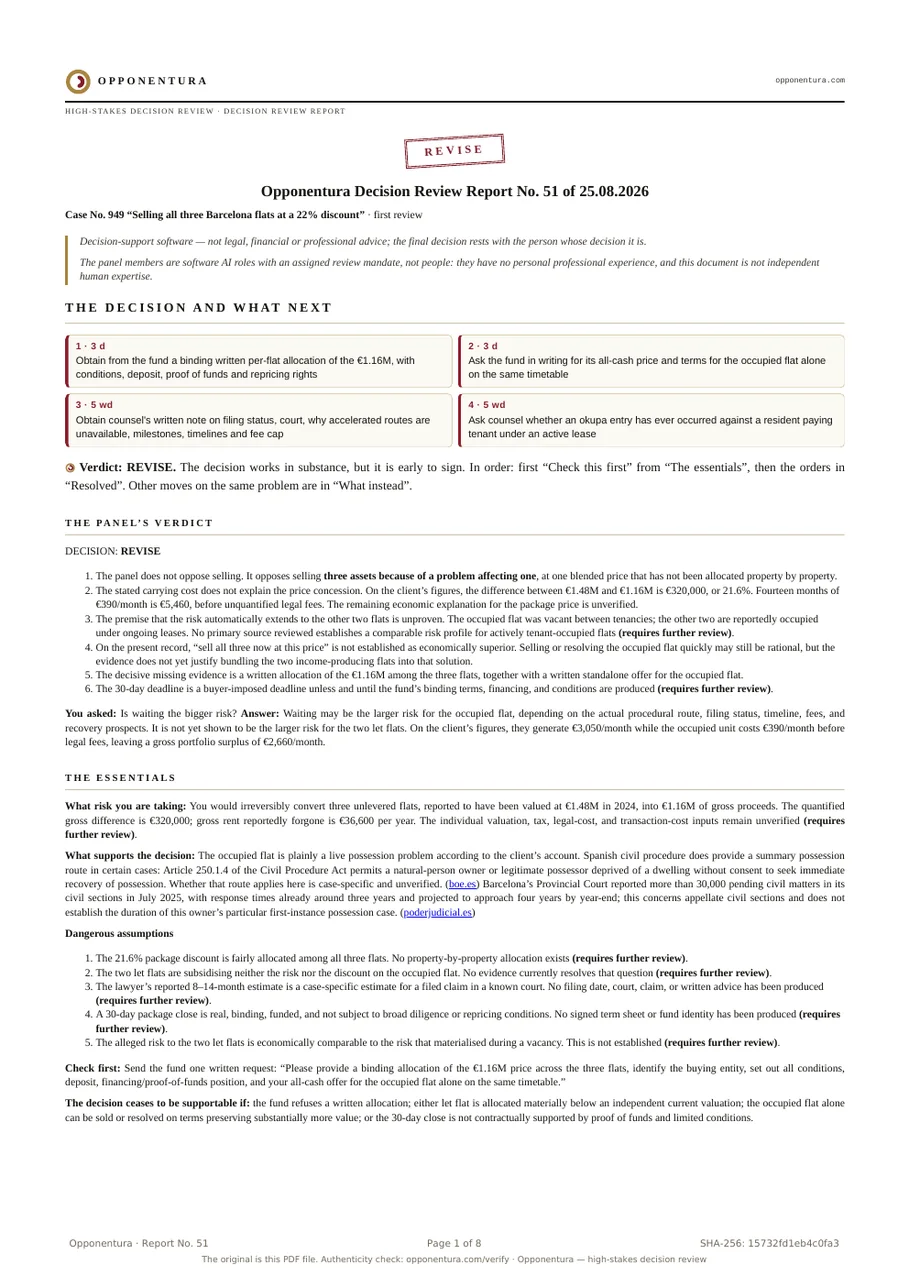
1 Verdict
The panel’s conclusion on this version of the decision — not a score of the person making it. Here: REVISE, unanimously.
2 The case and the hearing
The question gets a number and a name. You can come back to it: a repeat hearing convenes the same panel and starts by reporting on the previous action items.
3 Findings by severity
Each one names the damage scenario, the grounds and a verifiable next step. “Critical” and “high” require all four at once — the refund guarantee depends on how many there are, so overstating severity would be in our interest.
4 The essentials
Right after the verdict, on every plan, five answers: the risk you are taking, what holds the decision up, the three most dangerous assumptions, the cheapest check to run before the irreversible step, and the condition under which the decision stops being right.
5 Integrity hash
Every page footer carries the SHA-256 of the file. The original is the PDF file: a printout or a retelling is a reading copy, the proof is the file itself, and any recipient can verify it against our registry. The report itself runs three to four pages: the verdict, what to check first and what to do. How the panel got there — positions, argument, vote, sources — sits in a separate appendix whose fingerprint is printed in the report. We do not translate and reseal reports as “originals” — any change would produce a different hash.
No twenty-screen questionnaire
Three steps
Describe the situation
5–15 minutes. What you are about to do, what is at stake, which alternatives you considered and when the decision is actually due. Attach documents as they are — we do not ask for originals, signatures or stamps.
Challenge the frame before accepting the question
We test not only the proposed move, but how the problem itself has been framed: what is treated as fact, which options were excluded early, what remains unknown and how the situation looks to other parties. Then the review tests the numbers, assumptions, alternatives and consequences.
Get a concrete next step
What you may be missing · what to verify · what to change · when to proceed · when to stop.
What happens under the hood
Intake. Five questions are always asked — they are listed below, in the “Five questions” section. Anything already answered is not asked again; before a question you could find personal, we explain in one line why it is needed.
Separate passes, then debate. Critics form their positions separately — the first answer does not frame the rest — and the panel attacks the decision, not the person. Right after the transcript comes a map of disagreement: where the critics agree, where they split, and what fact would resolve it.
Checks before sealing. Three separate passes — external facts, proportionality of the criticism, document consistency; more in the “Protection against overreaction” section below.
If part of the work did not happen. A minor gap is named on the first page of the report and the hearing counts as usual. But if what the conclusion rests on did not run, we do not issue a report like that at all, and the hearing is not counted against you.
Documents. Whatever is missing is described as missing — that is a note on the completeness of the case, not a reproach. The other way round too: the more fully you open the case, the closer the review lands to reality.
After the report. A short decision card arrives with the document —
one screen you can act on; the document itself stays the PDF. Action items become a
follow-up plan in the bot: /orders to mark them done,
/calendar for control dates, and later we ask how it ended.
Telegram, on purpose. The review runs in Telegram because it keeps the fewest links between you and us: no web account, so no forms, passwords, sessions or third-party widgets. What we do not claim: the chat is an ordinary Telegram chat, not a “secret” one, and the content of the case is read by model providers. That is true of any channel.
Video · 5 minutes
Understand Opponentura in five minutes
You do not need to read the entire site to understand the idea. The first short video explains why an important decision may deserve a separate stress-test. The second shows what actually happens — from the first questions and uploaded documents to the panel, verdict and final report.
What is Opponentura? 2:02
How a smart person with a strong team can still solve the wrong problem — and what is worth checking before an expensive or hard-to-reverse decision.
Spoken in Russian, with English subtitles burned in.
How to use Opponentura 2:59
A real walkthrough: the first five questions, the conversation with the panel, documents, independent AI roles, debate, verdict and the full Decision Review Report.
Spoken in Russian, with English subtitles burned in.
Have a decision worth stress-testing? Opponentura first checks whether a separate review is warranted at all.
Quick self-check · 5 questions
Does this decision even need a red team?
Sometimes the right answer is “no.”
Answer five questions — and see whether a review is needed at all. Sometimes the honest answer is “do not convene the panel.”
This is the one place on the site where we can talk you out of our own service. We would rather say it before you pay than after.
No AI call · answers are not stored · the calculation runs in your
browser. The same five questions are /worth in the bot.
Protection against overreaction
We check whether our own criticism is proportionate
Opponentura is built to look for problems. That creates its own failure mode: treating every ordinary business risk as decision-changing.
Business requires risk. The existence of downside does not automatically mean the decision is wrong. What matters is the size of the downside, reversibility, the assumptions it depends on, and whether you are deliberately accepting it.
Before sealing, a separate review on another provider’s engine asks: what genuinely changes the decision, what is a normal cost of doing business, and what the panel failed to find. It may lower the severity of a finding, but it cannot raise it or rewrite the verdict.
What decisions do people bring?
Buying out a co-founder
What often gets missed. The price is negotiated carefully; exit terms, liabilities, customer dependency and what actually transfers are not.
What the review should produce. The conditions to renegotiate, what must be verified before signing and what would make the deal stop making sense.
Replacing a key executive
What often gets missed. The decision about the person gets mixed with customer continuity, access, handover, key-person dependency and transition timing.
What the review should produce. A map of business consequences, transition steps and facts to verify before action. Opponentura does not score the individual or make the employment decision: it reviews the business and operational consequences of the course you propose.
Taking on a large commitment
Financing, a guarantee, a lease or a long-term commercial obligation.
What often gets missed. The base case is modelled; the point at which the commitment stops surviving a revenue drop or cash delay is not.
What the review should produce. The threshold that should trigger a rethink and what to change before signing.
Five more decision types — litigation, expansion, shutting a line, pricing and automation — on the Cases page. Personal decisions are reviewed with the same procedures and live separately.
Why is this not just another AI answer?
General AI conversation
- the user provides the starting frame;
- disagreement has to be deliberately orchestrated;
- source checking depends on the prompt and mode;
- once the answer ends, follow-up is ad hoc.
Opponentura
- the framing itself is challenged;
- critics work separately before debate;
- external facts go through a dedicated review;
- the output carries assumptions, tests, revision conditions and action items;
- the decision can be revisited after the report.
Opponentura uses large language models and inherits their limitations. The difference is the review procedure, not a claim that the underlying models are infallible.
Under the hood
18 procedures for different kinds of failure
One critic, however capable, can repeat the same style of reasoning. Opponentura therefore breaks the review into 18 procedures: strengthening the case before challenging it, premortem, key-assumption checks, competing explanations, verification chains, scenario tests and others.
Four procedures are mandatory. The rest are assigned to different roles depending on the case, so that the critics do not merely paraphrase one another.
Before you trust a decision to us
Models can be wrong
We publish the limits of the method and do not call separate AI passes “independent human expertise”.
You can keep the case de-identified
A real name or company name is not required for the review. Personal data about third parties should not be sent at all: replace names with roles.
You control retention
/privacy in the bot:
the ordinary term, deletion within an hour of delivery, or an anonymous mode
that leaves no trace of the case.
We measure the site, never the case
Traffic sources and a few page actions — with your consent, through Google Analytics with advertising features and session replay switched off. Your decision, your documents and your conversation never reach web analytics.
Five questions before a high-stakes decision
These are the same five questions the review starts with. You can use them without Opponentura.
- What exactly am I about to do?
- What happens if I do nothing?
- What would getting it wrong cost me: money, time, relationships, reputation?
- Which alternatives have I already rejected — and why?
- By what date does this really have to be decided, and what sets that date?
If the answers are vague, clarify them before the irreversible step — whether or not you use the service.
What it costs
Your first review
The first verdict is free — what it includes is described above.
15 € — unlock the full sealed report, already written; it will wait 7 days for your decision.
Later reviews
From 30 € — from testing a single decision to comparing several options and long-term follow-up. The “Panel” plan comes with our refund guarantee.
Guarantee — on the “Panel” plan. If, on your first payment for this plan, the report contains no material objection — a finding rated “critical” or “high”, or an action item from the resolutions — we refund the full amount. You have 7 days from delivery to claim it. The number of material objections is counted by the program and printed inside the document itself. The full rule is in the plans section.
Why I built Opponentura
I own and run a business, and I make decisions I pay for with my own money. I already have partners, employees, lawyers and advisers. What I was missing was a separate process whose only job was to test what the plan rests on, what we were taking on faith, and what fact should make us change our mind.
The first plan Opponentura reviewed was the launch of Opponentura itself. The result was REVISE. We are still working through some of the action items.
I cannot promise that Opponentura will prevent a bad decision. I made it available to others because I want decision-makers to have one more chance to notice what is invisible from inside their own frame, before a costly or hard-to-reverse commitment.
Vadim Kamashev, founder
Why I opened it to other decision-makers →
Where this project came from
If you want the story behind the service, not only the mechanics — here is the full version. Spoken in Russian, with English captions on by default.
▸ Watch the long version — 6:48
Own mistakes, entrepreneurial risk, trying to step outside your own frame — and why the first thing Opponentura reviewed was Opponentura itself.
This is the six-and-a-half-minute version people have already managed to call long and boring. That is why the two short videos now sit higher up the page.
Full transcript (English translation)
0:00 A friend of mine, Vadik, said to me recently, are you even sure that this Opponentura of yours is needed by anybody at all? You're a doubter yourself, you're used to double-checking everything, but leading is the opposite — you must be confident and lead people. And people generally don't like being told they might be wrong. And here I partly agree with him.
0:23 Opponentura really isn't for everyone, and not for every decision. And I write about that on the site, by the way, so that you can also check whether you actually need it or not. I'm Vadim Kamashev, an entrepreneur, over 20 years in business, before that I worked in private business as a hired hand. Right now I have several active projects.
0:49 Some projects were successful, some I walked away from with a loss. In short, I'm definitely not a guru who's going to tell you how to make the right decisions. Overall, by my entrepreneurial track record, it's been about 50/50, successful and unsuccessful projects. I've made plenty of mistakes with my own money. And that same friend, by the way, says to me, but you understand that business is about risk.
1:20 And if Opponentura keeps saying there are too many risks, then you could never go into business at all. But with that I don't agree. Sure, business without risk basically doesn't exist. An entrepreneur often acts on incomplete information, and that's normal. But it's one thing when I understand how much I can lose, I understand some key assumptions, and I still say, yes, I accept this risk and the potential outcome is worth it.
1:52 the potential profit outweighs the risks. And it's a completely different thing when I think I'm taking on one risk, but I'm actually taking on a totally different risk, one I never thought about, one nobody told me could even exist. Because some important, critical assumption was never thought through, or the consequences turned out bigger than I expected.
2:20 and you want to see all of that before, not after. So, and of course, when I look back at some of my own decisions, the bad ones, I don't think that if I'd had Opponentura, I would never have made that decision. Of course, that wouldn't be true. Some decisions I'd still have gone ahead with and could still have lost, but some decisions, I realize, I wouldn't have gone into.
2:46 Or I'd have gone in on different terms. Maybe I'd have slept on it one more night, thinking through that fork in the road that Opponentura pointed out to me. That's why I built this service. That's what it's for. I didn't need one more opinion or more criticism. I don't need a machine that says "no." I needed a procedure, methods, ideally with some scientific grounding.
3:15 Inside there's a method called O-18, it's 18 ways to test a decision. Key assumptions, premortem, the butterfly, base rates, and so on. Popper's falsifiability, cognitive biases, framing, and so on. These are all methods from logic, from the intelligence community, and so on. But it's not even the methods that matter most. Everything under the hood matters less compared to the fact that Opponentura reaches a decision, suggests a decision, using not one method but many methods.
3:55 For me, in business and in life, three things matter when deciding. What might I be missing, what needs to be tested first, before some irreversible step. And most importantly, under what conditions do I go forward, and under what conditions do I have to revisit my decision. And by the way, in Opponentura even the criticism itself gets checked for proportionality. Because being that negative and seeing a catastrophe everywhere, in every entrepreneurial risk, that's obviously also an error and a bias.
4:28 So the value of this service for me is the method and the procedure. And the first thing I did was point Opponentura at Opponentura itself. And the verdict was REVISE. Yes, it told itself to go back and rework it. The value for me, like I said, wasn't in the criticism, it was that it became clearer what needed to change, what still needed to be double-checked, and under what conditions the decision should be revisited.
5:05 Those are the three things Opponentura solves. So for me Opponentura isn't about loving criticism. Criticism is just one of the mechanisms. The goal is clarity and control before an important decision in life or in business. A leader absolutely needs confidence. An entrepreneur absolutely takes on risk. but it's better to have that confidence after a check, not instead of one.
5:34 And to take risk consciously, not discover risks after the fact. That's exactly what I built Opponentura for, for myself. In a couple of words, how Opponentura works — I made it as simple, native, and organic as possible. You just describe, in your own words, some problem or some options you're considering. you can attach documents, you can even talk in voice messages on Telegram.
6:00 Opponentura can reply to you with audio too. It convenes the panel, the members, who independently discuss your decision, they go through deliberation, a dissenting opinion may come out of it, and at the end you get a report, a PDF with the next steps you need to take, certified with a seal and a unique hash. You don't need to give your name, in fact we ask you not to.
6:30 We don't need personal data. I hope Opponentura will let you widen your lens on decision-making and reduce the chance of the most costly mistakes in business, and in your life generally.
Early access
The decision is nearly made?
Spend 5–15 minutes looking for the fact or assumption that could still change the move — before the move becomes expensive to reverse.
Review a decision — first verdict free See a real report
Reports come in the language of your case — write in English and the sealed report is English. The final decision always remains with the person making it.
Questions
Won’t Opponentura just talk me out of every risky decision?
It should not — that is what the process is built for: before sealing, the report goes through a separate proportionality review (see “Protection against overreaction”). The purpose is to distinguish a downside you understand and deliberately accept from an untested assumption. That review can be wrong too; the final decision remains yours.
Do you only criticize, or do you propose what to do?
Both. If you already have a decision, Opponentura tests it and produces concrete changes and action items. If you do not yet have a decision, the system can put several genuinely different moves on the table and then test the one you choose. If the current move receives REVISE or REJECT, the full report can include alternative moves — clearly marked as not yet reviewed until you submit them for a separate review.
Why not just use ChatGPT?
For many questions, you should. Opponentura is for situations where you want the review procedure to be mandatory: separate critic passes, structured disagreement, dedicated fact review, explicit revision conditions and a follow-up action plan.
What if the panel is wrong?
It can be. The service does not know the future and does not promise a correct decision. That is why it publishes its limitations, reviews external claims separately, checks whether criticism has been overstated, and asks what happened in reality after the review.
Do I need documents?
No. Attach them when they can change the analysis, as they are. Without them the review proceeds from your description, and whatever was taken on trust is marked as such.
Is it safe to describe my business?
Keep out anything the analysis does not need: replace names with roles, and do not send personal data or bank details. The content of the case is processed by third-party AI providers under the rules described in the privacy notice. You choose how long the material is kept.
When do I need a human expert?
Whenever the decision turns on a fact only an insider or on-site expert can establish, and whenever the law or the task requires a qualified professional opinion, signature or professional responsibility. A Decision Review Report is useful partly because it shows what to take to the human expert.
How long does it take?
Describing the case usually takes 5–15 minutes. The result is usually delivered the same day. If a review runs longer than a day, we write to you first, call the delay ours and offer a choice — wait or take a refund.